
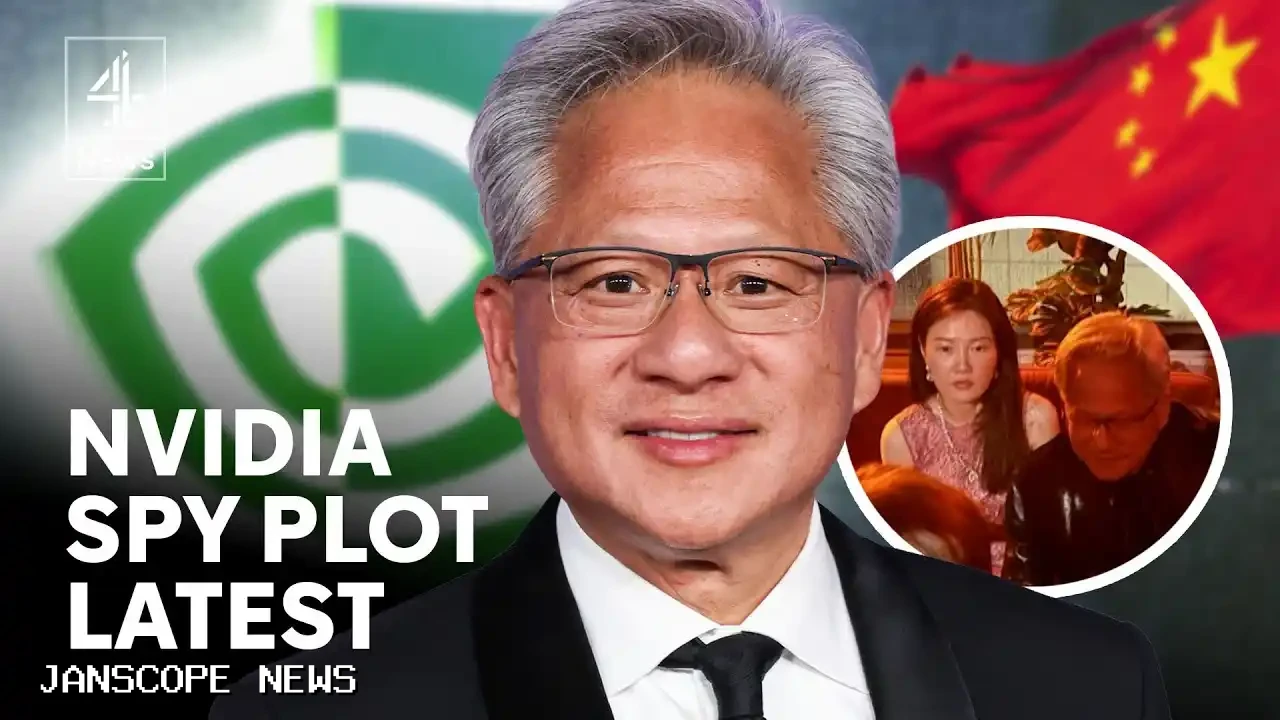
SANTA CLARA, Calif. — Nvidia's board of directors opened an internal investigation in November 2026 after CEO Jensen Huang admitted to an extramarital affair with Alice Huang, a senior executive at Singapore-based data center operator Megaspeed International. US intelligence officials have monitored the pair for over a year to determine whether Chinese state security used the relationship to influence US semiconductor export policy or access restricted Nvidia hardware through roughly $4.6 billion in chip purchases.
Wait for the distinction that actually matters here. Federal counterintelligence agents have not accused the Nvidia chief of handing over chip schematics or source code. The concern inside Washington and Silicon Valley is subtler: whether a foreign influence campaign used personal closeness and massive commercial orders to turn America's most important hardware executive into an advocate against US export controls.
How the 2024 to 2026 intelligence and corporate timeline unfolded
Tracing how a personal relationship turned into a boardroom and national security crisis requires looking at the sequence of events across Taipei, Singapore, and Washington over the past two years.
June 2024: The Taipei meeting and Megaspeed's entry
Jensen Huang and Alice Huang were photographed together at an industry party in Taipei in June 2024. Around that period, Alice Huang held a senior post at Megaspeed International, a Singapore-registered data center infrastructure firm.
Before joining the semiconductor infrastructure sector, she had built a resume spanning Chinese state broadcaster CCTV, Hunan TV, and global banking giant HSBC, though western investigators later noted gaps in independently verifying parts of her early career history. US counterintelligence officials subsequently assessed that she maintained ties to China's Ministry of State Security (MSS).
Late 2025: US intelligence monitoring and the $4.6 billion chip pipeline
By late 2025, US intelligence agencies had placed the relationship under active surveillance and briefed President Donald Trump on the counterintelligence risks. During this window, Megaspeed International placed approximately $4.6 billion (roughly Rs 45,000 crore) in orders for advanced Nvidia AI processors.
Because the U.S. Bureau of Industry and Security bars the direct sale of top-tier Nvidia GPUs to mainland Chinese entities, regulators watch third-party hubs like Singapore closely for physical smuggling. Megaspeed took a different route. When Nvidia conducted unannounced physical audits of Megaspeed's facilities, every processor was sitting on its racks in Singapore exactly as contracted. Rather than shipping hardware across borders, Megaspeed allegedly provided backend cloud computing capacity that supported AI operations linked to Chinese tech giant Alibaba.
May 2026: The Alaska stopover on the presidential trade trip
The quiet intelligence probe nearly spilled into public view during President Trump's May 2026 trade mission to China. While top American executives including Apple's Tim Cook and BlackRock's Larry Fink were on the initial manifest, Jensen Huang was noticeably excluded from the primary delegation flight due to the ongoing security review.
After business outlets reported on the omission of America's leading AI hardware chief from a China trade summit, the administration adjusted course mid-trip. Air Force One made a stopover in Alaska, where Huang joined the delegation via a separate aircraft while the White House publicly dismissed the earlier reporting.
October 2026: Public lobbying against export bans and the NYT report
In October 2026, Jensen Huang gave a public interview to Bloomberg arguing that Washington's refusal to sell advanced AI chips to China was a strategic mistake that hurt American companies. For counterintelligence officials watching the case, those remarks raised immediate questions about whether Alice Huang had nudged the CEO to use his political capital with the White House to soften export restrictions.
On October 29, 2026, The New York Times broke the initial story identifying the Nvidia chief as the target of a suspected Chinese intelligence operation.
November 10, 2026: Staff apology, board inquiry, and market drop
Following days of viral social media clips and intensifying scrutiny, Huang sent an internal memo to Nvidia employees acknowledging the affair.
"I was unfaithful to my wife. My actions hurt her and our children. There is no excuse for what I did," Huang wrote to staff, adding that he took full responsibility for the pain caused to his wife, Lori Mills, and their family while pledging his commitment to the company.
Following the disclosure, Nvidia's board of directors launched a formal review to examine whether personal ties affected any corporate decisions, pricing, or allocation of chips to Megaspeed. When trading reacted to the news on November 10, 2026, Nvidia shares dipped briefly, erasing roughly $7.4 billion from Huang's personal net worth in 30 minutes and knocking him down two spots on the Forbes real-time billionaires list before the stock stabilized.
Why Washington cares more about cloud loopholes than stolen blueprints
Most public commentary around corporate espionage assumes the goal is stealing a blueprint from a safe. In modern semiconductor manufacturing, a blueprint alone does you very little good. Even if an operative walked out of Santa Clara with every file on Nvidia's latest architecture, China cannot easily replicate those chips domestically without extreme ultraviolet (EUV) lithography machines from Dutch supplier ASML, which are also under strict western export bans.
What Chinese AI developers actually need right now is raw compute time to train frontier models. After Chinese startup DeepSeek demonstrated in recent years that it could build competitive models using older, pre-ban chips stockpiled before 2022, Washington tightened the screws on hardware exports.
That restriction created the Singapore cloud loophole:
A company registered outside mainland China legally buys billions of dollars in Nvidia GPUs.
The physical servers stay inside a Singapore data center, passing every physical inspection by Nvidia compliance teams.
Chinese AI engineers rent access to those servers remotely over high-speed fiber, training large language models without a single silicon wafer ever crossing the Chinese border.
What Nvidia's board and US lawmakers are investigating next
Two parallel tracks now determine whether Jensen Huang keeps his job atop the $4.5 trillion company he co-founded with Chris Malachowsky and Curtis Priem in 1993.
First, Nvidia's independent directors must verify that Megaspeed received standard commercial terms. When global tech giants like Microsoft, Google, and Meta are waiting months in line for GPU clusters, allocating $4.6 billion worth of scarce silicon to a relatively new Singapore operator draws immediate audit scrutiny. If Huang bypassed internal compliance flags or fast-tracked shipments for Alice Huang's firm, the board faces serious governance liability with shareholders.
Second, US congressional committees are preparing to summon Huang for testimony regarding foreign influence and export compliance. While President Trump responded mildly to reporters after the news broke — calling Huang "a very nice person" and indicating he would still include him on future Asian trade trips — lawmakers on Capitol Hill are pressing the Commerce Department to close remote-access data center loopholes in Southeast Asia.
Frequently asked questions about the Jensen Huang investigation
Who is Alice Huang and what is her connection to Megaspeed International?
Alice Huang is a senior executive at Megaspeed International, a data center company based in Singapore. Prior to entering the tech infrastructure sector, she worked in Chinese media (including CCTV and Hunan TV) and investment banking at HSBC. US intelligence officials suspect she has links to China's Ministry of State Security.
Has Jensen Huang resigned as CEO of Nvidia?
No. As of November 10, 2026, Jensen Huang remains CEO of Nvidia. In his internal letter to employees apologizing for his extramarital affair, he stated he remains committed to leading the company and is cooperating fully with the board's review.
Did Jensen Huang leak classified Nvidia chip secrets to China?
There is currently no public evidence or formal charge that Huang handed over proprietary technical blueprints or source code. The investigation focuses on potential corporate conflicts of interest, GPU allocation to Megaspeed, and whether he was influenced to lobby against US chip export bans.
How did Singapore's Megaspeed get $4.6 billion in Nvidia chips legally?
US export controls primarily restrict the shipment of advanced AI chips to mainland China and specific blacklisted entities. Because Megaspeed operates in Singapore and kept the physical hardware inside its local facilities during Nvidia inspections, the shipments did not violate territorial export bans at the time of delivery.
How is Alibaba connected to the Megaspeed data center controversy?
Intelligence findings cited in recent reports indicate that while Megaspeed kept its Nvidia processors in Singapore, the company provided backend data center capacity and computing services that supported AI development for Chinese tech conglomerate Alibaba.
How much money did Jensen Huang lose after the scandal broke?
During the initial market sell-off following the November 2026 disclosures, a sharp dip in Nvidia's stock price reduced Huang's paper net worth by approximately $7.4 billion within half an hour, dropping him two positions on the global billionaire rankings before shares partially recovered.
Who is Jensen Huang's wife and do his family members work at Nvidia?
Jensen Huang is married to Lori Mills, whom he met while attending Oregon State University. The couple has two adult children, Spencer Huang and Madison Huang, both of whom hold management roles within Nvidia's product and marketing divisions.
What is Jensen Huang's nationality and background?
Huang was born in Tainan, Taiwan, in 1963 and moved to the United States as a child. He is a US citizen, educated at Oregon State University and Stanford University, and founded Nvidia in California in 1993.


No comments yet — be the first to share your thoughts!