
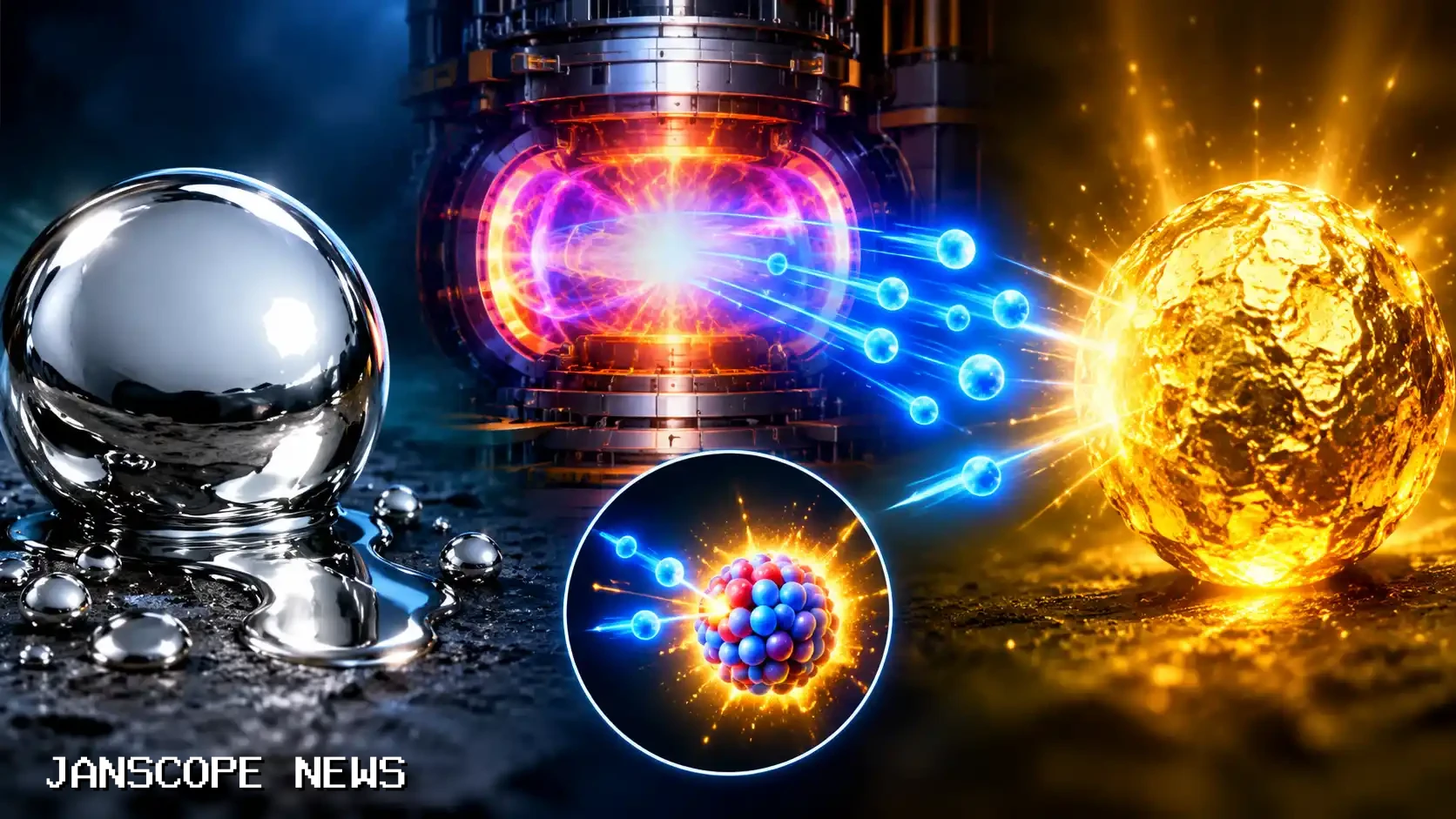
SAN FRANCISCO — Marathon Fusion, a California-based nuclear energy startup, announced on October 21, 2026, that it has successfully converted mercury into real, stable gold using fusion-generated neutrons. Posted via an official technical update on X (formerly Twitter), the company stated it achieved "high-rate alchemy" at a production rate 10 times higher than the benchmark set by the European Organization for Nuclear Research (CERN) in 2025.
To verify the conversion, Marathon Fusion shared gamma-ray spectroscopy measurements showing the presence of radioactive mercury-197 decaying directly into stable gold-197 after irradiation. While the company confirmed the isotopic transition and rate increase, it did not disclose the total mass of gold produced during the October 2026 experimental run.
The announcement follows a July 2025 technical paper on the arXiv preprint server in which Marathon Fusion co-founders Adam Rutkowski and Kyle Schiller first proposed integrating mercury into the breeding blankets of commercial fusion reactors. By moving from theoretical modeling in 2025 to experimental neutron irradiation in October 2026, the company aims to prove that byproduct revenue from precious metals and medical isotopes can subsidize the high capital costs of future fusion power plants.
How Marathon Fusion Converts Mercury-198 Into Stable Gold-197
Marathon Fusion uses nuclear transmutation rather than chemical reactions, bombarding stable mercury-198 atoms with high-energy neutrons from deuterium-tritium fusion to strip away a single neutron and initiate radioactive decay into stable gold-197.
Unlike classical chemistry, which only rearranges electrons around an atom's exterior, nuclear transmutation alters the nucleus itself. The element an atom belongs to is strictly defined by its proton count: mercury has 80 protons, while gold has 79.
Marathon Fusion executes this conversion through a three-step nuclear pathway known in physics as an $(n, 2n)$ reaction:
Neutron Bombardment: A deuterium-tritium (D-T) fusion source generates high-energy neutrons carrying approximately 14 megaelectronvolts (MeV) of kinetic energy.
Isotopic Stripping: These fast neutrons strike natural mercury-198 ($^{198}\text{Hg}$), a stable isotope that makes up roughly 10% of naturally occurring mercury. The impact knocks one neutron out of the nucleus while the incoming neutron is deflected, leaving behind unstable mercury-197 ($^{197}\text{Hg}$).
Electron Capture Decay: Mercury-197 has a half-life of roughly 64.1 hours. As it decays via electron capture, one of its 80 protons absorbs an inner-shell electron and transforms into a neutron. This drops the atomic number from 80 to 79, turning the atom into gold-197 ($^{197}\text{Au}$)—the only naturally occurring, completely stable isotope of gold.
In its October 21, 2026 disclosure, Marathon Fusion provided gamma-ray spectra identifying the specific photon energy peaks emitted during the 64-hour decay window of mercury-197, alongside the subsequent stabilization into gold-197.
Marathon Fusion vs. CERN and Historical Transmutation Benchmarks
Marathon Fusion achieved a production rate 10 times higher than CERN's 2025 Large Hadron Collider experiment because fusion systems generate dense streams of neutrons, whereas particle colliders rely on rare electromagnetic grazing collisions between lead ions.
Turning base metals into gold is not new to nuclear physics, but historical methods at facilities like the Lawrence Berkeley National Laboratory and CERN have always consumed vastly more energy and money than the resulting microscopic gold was worth.
| Metric / Feature | Glenn Seaborg Team (1980) | CERN LHC ALICE Experiment (2025) | Marathon Fusion Experiment (Oct 2026) | Marathon Commercial Target (2025 Paper) |
| Starting Element | Bismuth-209 ($^{209}\text{Bi}$) | Lead-208 ($^{208}\text{Pb}$) | Mercury-198 ($^{198}\text{Hg}$) | Enriched Mercury-198 Blanket |
| Reaction Method | Relativistic carbon/neon beams | Ultraperipheral photon-nucleus collisions | 14 MeV Deuterium-Tritium fusion neutrons | Full-scale fusion reactor breeding blanket |
| Gold Output / Rate | A few thousand atoms total | ~89,000 nuclei/sec (~29 picograms total) | 10x CERN's 2025 production rate | ~2,000 to 5,000 kg per GWth/year |
| Isotope Stability | Mostly radioactive gold isotopes | Stable $^{197}\text{Au}$ (short-lived in beam) | Stable $^{197}\text{Au}$ via $^{197}\text{Hg}$ decay | Stable $^{197}\text{Au}$ (requires cooling storage) |
| Primary Purpose | Heavy-ion physics research | Studying electromagnetic dissociation | Proof-of-concept for fusion economics | Doubling fusion power plant revenue |
In May 2025, researchers working on the ALICE detector at CERN reported that ultraperipheral collisions of lead-208 nuclei in the Large Hadron Collider stripped three protons from lead atoms to create gold. However, CERN produced only about 29 picograms (2.9 trillionths of a gram) of gold across several years of run time—hardly enough to detect outside a particle tracker.
By switching the feedstock from lead (82 protons) or bismuth (83 protons) to mercury (80 protons), Marathon Fusion only needs to trigger a single proton-to-neutron conversion rather than stripping multiple protons at once. Furthermore, neutron capture and $(n, 2n)$ reactions inside a dense liquid mercury target occur at much higher cross-sectional probabilities than ultra-high-energy collider grazing events.
The Economics of Fusion Alchemy: Why 2 Tons of Gold Per Gigawatt Matters
According to Marathon Fusion's 2025 engineering models, lining a 1-gigawatt thermal fusion reactor core with a mercury breeding blanket could produce roughly 2 tons of gold annually, potentially doubling a power plant's revenue without reducing electricity output.
The central obstacle to commercial fusion energy is capital cost. Building a utility-scale tokamak or inertial confinement plant requires billions of dollars in superconducting magnets, vacuum vessels, and shielding before a single watt of electricity is sold to the grid.
In its 2025 blueprint, Marathon Fusion proposed turning the reactor's "breeding blanket"—the protective lining surrounding the plasma core—into a dual-purpose chemical factory. Standard D-T fusion reactors must surround their cores with lithium blankets. When fusion neutrons hit lithium, they breed tritium, the radioactive hydrogen isotope needed to keep the fusion fuel cycle self-sustaining.
Marathon Fusion argues that high-energy neutrons hitting mercury-198 do not just create mercury-197; they actually knock loose two neutrons for every one neutron absorbed. Because this $(n, 2n)$ reaction acts as a neutron multiplier, the freed neutrons can pass straight into the adjacent lithium layer to continue breeding tritium fuel, while the thermal heat generated still drives steam turbines for electricity.
Projected Output: Roughly 2 metric tons of gold per year for a 1-gigawatt thermal ($\text{GWth}$) plant (equivalent to up to 5 tons per gigawatt of net electrical output, depending on thermal efficiency and mercury-198 enrichment).
Value Proposition: At 2026 bullion prices, two tons of gold represent over $170 million in annual revenue—roughly matching the entire wholesale electricity revenue of a standard gigawatt-scale power station.
Caveat on Estimates: Marathon Fusion explicitly notes in its research that the 2-ton-per-year figure is a theoretical engineering projection for a future commercial power plant, not the physical yield of its October 2026 laboratory demonstration.
Producing Cancer-Fighting Isotopes: Copper-64 and Copper-67 From Zinc
Alongside its gold experiment, Marathon Fusion used fusion neutrons to irradiate zinc and successfully produce copper-64 and copper-67, two scarce radioactive isotopes used in targeted cancer diagnostics and radiotherapy.
While transmuting mercury into gold captures headlines, the immediate commercial market for Marathon Fusion's neutron technology lies in nuclear medicine. In its October 21, 2026 announcement, the company revealed it had irradiated natural zinc targets with fusion neutrons to create copper-64 ($^{64}\text{Cu}$) and copper-67 ($^{67}\text{Cu}$).
These two isotopes form what oncologists call a "theranostic pair"—combining therapy and diagnostics using the exact same chemical element:
Copper-64 (Diagnostics): With a half-life of 12.7 hours, $^{64}\text{Cu}$ emits positrons suitable for high-resolution Positron Emission Tomography (PET) scans. Doctors attach it to tumor-seeking peptides or antibodies to map the exact location of metastatic cancers.
Copper-67 (Targeted Therapy): With a half-life of 61.8 hours, $^{67}\text{Cu}$ emits beta particles that destroy cancer cells at close range without damaging surrounding healthy tissue. Because it is chemically identical to $^{64}\text{Cu}$, doctors can swap the diagnostic isotope for the therapeutic isotope using the exact same targeting drug.
Historically, copper-67 has been bottlenecked by severe global supply shortages, relying on a handful of aging government linear accelerators and research reactors referenced by the U.S. Department of Energy Isotope Program. Unlike gold—which must be produced in metric tons to change energy markets—medical isotopes sell for thousands of dollars per millicurie. Marathon Fusion can monetize small-scale fusion neutron generators for medical supply chains years before a gigawatt-scale fusion power grid ever comes online.
Technical Hurdles and Radiation Risks Left to Solve
Before fusion-transmuted gold can enter commercial markets, engineers must solve the costly isotopic enrichment of mercury-198 and manage trace radioactive gold-196 contaminants that require up to 17 years of shielded cooling storage.
Independent nuclear physicists reviewing Marathon Fusion's 2025 paper and 2026 experimental claims point out four major engineering barriers between a laboratory gamma-ray spectrum and commercial gold bars:
Natural Mercury Impurity: Natural mercury contains seven stable isotopes, and mercury-198 makes up only 9.97% of the mix. If unseparated natural mercury is placed in a reactor, neutrons striking heavier isotopes (like mercury-199 or mercury-200) simply create other stable mercury isotopes rather than gold. Commercial viability requires expensive industrial-scale isotope enrichment of mercury-198 first.
Radioactive Gold-196 Contamination: Fast fusion neutrons occasionally trigger over-reactions or secondary knockouts, producing gold-196 ($^{196}\text{Au}$) or gold-195 ($^{195}\text{Au}$). While gold-197 is completely stable and non-radioactive, trace amounts of these unstable isotopes mean the freshly extracted gold cannot be handled safely right away. Calculations indicate the gold would need to sit in secure radiation storage for 14 to 18 years for the trace radioisotopes to decay below regulatory clearance limits.
No Commercial Fusion Reactors Exist Yet: The 2-ton annual gold projection requires a continuously operating 1-gigawatt D-T fusion power plant. As of October 2026, no private company or government project has achieved continuous, net-electric commercial fusion power.
Chemical Extraction from Liquid Metal: Separating parts-per-million quantities of solid dissolved gold out of tons of toxic, irradiated liquid mercury inside a reactor loop presents severe corrosion and materials-handling challenges.
Frequently Asked Questions About Marathon Fusion's Gold Claim
Did a startup really turn mercury into gold in 2026?
Yes. On October 21, 2026, San Francisco startup Marathon Fusion announced it had experimentally transmuted mercury-198 into stable gold-197 using deuterium-tritium fusion neutrons, confirming the decay process via gamma-ray spectroscopy.
How much gold did Marathon Fusion actually make?
Marathon Fusion did not disclose the exact weight of the gold produced in its October 2026 experiment. While the rate was 10 times higher than CERN's 2025 record (which created 29 picograms), the total yield in this proof-of-concept test remained microscopic and detectable primarily through gamma-ray radiation signatures rather than physical bullion weight.
Is the gold created by nuclear transmutation radioactive?
Gold-197 itself is 100% stable and non-radioactive—identical to gold mined from the earth. However, the neutron bombardment process creates tiny trace amounts of unstable gold isotopes (such as gold-196) alongside it, meaning large batches produced in a future reactor would require roughly 14 to 18 years of cooling storage before becoming safe to touch.
Why did Marathon Fusion use mercury instead of lead?
Mercury (atomic number 80) has just one more proton than gold (atomic number 79), whereas lead has 82 protons. Knocking a single neutron out of mercury-198 so it naturally decays into gold-197 requires far less energy and occurs at a much higher probability than stripping three protons out of a lead atom.
Will fusion-created gold crash global gold prices?
No. Even if commercial fusion power plants come online in the 2030s or 2040s and produce 2 tons of gold per gigawatt annually, hundreds of reactors would still only generate a fraction of the roughly 3,600 metric tons of gold mined globally each year.
How to Track Verification and Next Steps
For readers, energy analysts, and investors evaluating nuclear transmutation claims, watch for two upcoming verification milestones: peer-reviewed publication of Marathon Fusion's October 2026 gamma-ray datasets in an accredited nuclear engineering journal, and potential commercial supply agreements for its copper-64 and copper-67 medical isotopes, which represent the company's most viable near-term revenue stream prior to grid-scale fusion deployment.



No comments yet — be the first to share your thoughts!