
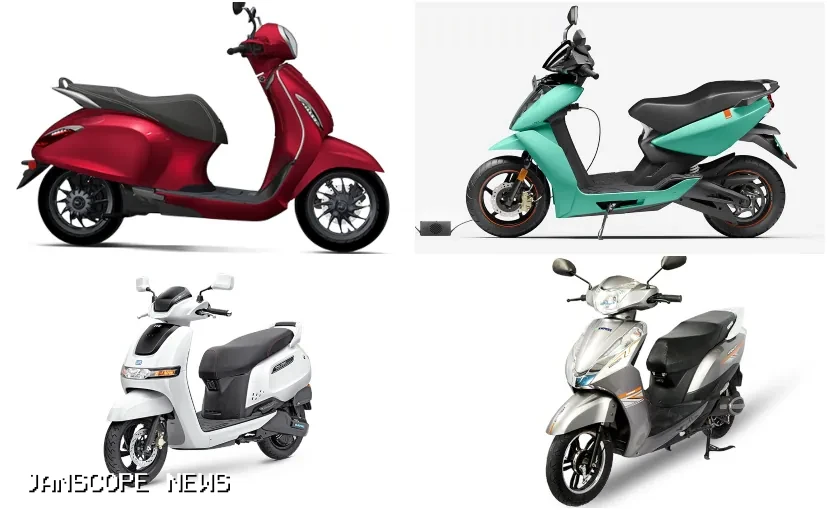
22 October 2026. Electric two-wheelers made up about 11.4% of all two-wheeler registrations in September 2026, with TVS first, Bajaj second and Ather third. Registrations from January to September 2026 reached about 15.61 lakh, already above the 13.42 lakh recorded in all of 2025. Sources put September at 1.97 to 2.07 lakh units, depending on the Vahan download date.
Prices and specs move often, and the same scooter is listed at different prices on different sites. Every figure below carries a date and a source. Items I could not confirm are marked [VERIFY].
What changed for buyers in 2026, in order
| Date | What happened | Why it matters |
|---|---|---|
| 27 Mar 2026 | A Ministry of Heavy Industries notification set the e-2W incentive window to end on 31 July 2026. | Buyers had a four-month countdown. |
| 1 Jun 2026 | Ather raised prices. | The "launch price" you read in May is out of date. |
| 16 Jul 2026 | Ather reconfigured the Rizta battery packs. | Older range claims describe packs you can no longer buy. |
| 31 Jul 2026 | The incentive window lapsed, and buyers went about ten days without the central subsidy. | Some bookings in early August carried no subsidy. |
| 10 Aug 2026 | A new notification extended e-2W incentives to 31 March 2028 at ₹2,500 per kWh, capped at ₹5,000. | The subsidy is back, but at half the FY25 rate. |
| 2 Sep 2026 | Simple Wave launched, with deliveries promised from 25 September. | As of 1 Oct, MeraEV found no confirmed customer-delivery coverage. |
| 22 Sep 2026 | Honda QC3 launched at ₹1.35 lakh with a claimed 145 km range. | MeraEV reported no delivery date and no published top speed as of 1 October. |
| 12 Oct 2026 | VLF Strada launched at ₹1.20 lakh with a 98 kg kerb weight. | It is the lightest new option, but too new to rank. |
| Q1 2027 | Ultraviolette Tesseract deliveries are promised. | Worth waiting for only if you can hold off a few months. |
| 31 Dec 2027 / 31 Mar 2028 | The last date for subsidy claims is 31 December 2027, and no payments are made after 31 March 2028. | The scheme is fund-limited and can close early. |
Top 10 Electric Scooters at a Glance
Quick Comparison Table
Prices are the "from" ex-showroom Delhi figures on BikeDekho's electric scooter listing, read on 22 October 2026. Range is the claimed IDC figure, a lab number.
| # | Scooter | Price from (ex-showroom) | Battery | Claimed range | Top speed | Best for |
|---|---|---|---|---|---|---|
| 1 | TVS iQube | ₹1.20 lakh (ST ₹1.75 lakh) | 2.2–5.3 kWh | 94–212 km | 75–82 km/h | Most buyers |
| 2 | Bajaj Chetak 35 | ₹1.19 lakh | 3.5 kWh | up to 153 km | 70–80 km/h* | Boot space, build |
| 3 | Ather Rizta | ₹1.22 lakh | 2.7–3.5 kWh | 123–160 km** | 80 km/h | Families |
| 4 | Vida VX2 | ₹1.10 lakh | 2.2–3.4 kWh*** | 92–142 km*** | 70–80 km/h | Removable batteries |
| 5 | Ather 450X | ₹1.51 lakh | 3.5 kWh | up to 161 km | 90 km/h | City plus highway |
| 6 | TVS Orbiter | ₹1.01 lakh | 3.1 kWh | 158–168 km* | 68 km/h | Tight budgets |
| 7 | Ola S1 | ₹0.85 lakh (S1 X) to ₹1.70 lakh (Pro+) | up to 5.2 kWh | up to 320 km | up to 130 km/h | Spec-driven buyers |
| 8 | River Indie | ₹1.46 lakh | 4 kWh | 160–163 km | 90 km/h | Storage, utility |
| 9 | Ampere Nexus | ₹1.30 lakh | 3 kWh LFP | 136 km | 93 km/h | Value, long battery cover |
| 10 | Honda Activa e | ₹1.20 lakh | 2 × 1.5 kWh swappable | 102 km | 80 km/h | Swap-city commuters |
Best Overall Electric Scooter
TVS iQube. It led September 2026 model sales with 45,320 units. TVS offers five battery and price steps, so most budgets have a fit. The catch is that TVS says the iQube does not support fast charging.
Best Budget Electric Scooter
TVS Orbiter. It starts at about ₹1.01 lakh in Delhi on BikeDekho. The Ola S1 X is listed lower at ₹84,999. Ola's service reputation and falling share make the Orbiter the safer cheap pick.
Best Long-Range Electric Scooter
Ola S1 Pro+ (5.2 kWh) on paper, with a 320 km IDC claim. The TVS iQube ST is the more cautious alternative at 212 km. Plan for far less than either number (see the buying guide).
Best Commuter Electric Scooter
Bajaj Chetak 35 Series. It offers about 35 litres under the seat, a metal body and, on top variants, a touchscreen with Google Maps.
Best Lightweight Electric Scooter
TVS iQube 3.1 kWh. It weighs 116.8 kg. The Ather Rizta Z is close at 119 kg. The new VLF Strada is lighter still, but it launched ten days ago.
Top 10 Electric Scooters Reviewed
Ranking blends September 2026 sales, published specs, third-party tests where they exist, and service reach. It is an editorial judgment, not a lab score.
1. TVS iQube
Key Specifications
- Five variants: 2.2, 3.1, 3.5, S 3.5 and ST 5.3 kWh. Claimed range runs 94 to 212 km, and top speed 75 to 82 km/h by variant.
- Price: from ₹1,20,124 in Delhi on BikeDekho. The ST shows ₹1,75,384 there, while TVS's own blog quoted ₹1,61,984. Confirm at the dealer.
- The 3.1 kWh variant has a 32-litre boot and a hub motor.
- The ST takes about 6 hours 50 minutes for 0 to 80% on its 950 W charger.
Pros and Cons
Pros: the widest variant range here, the biggest sales volume, a big dealer and service network, and a very large battery on the ST.
Cons: no official fast charging, and a modest 4.4 kW motor on the ST makes two-up overtaking at 80 km/h tiring.
Who Should Buy It?
Buyers who want a low-drama daily scooter from an established maker. Pick the 3.1 or 3.5 kWh for city use. Pick the ST only if range anxiety is your biggest worry.
2. Bajaj Chetak 35 Series
Key Specifications
- Price: from ₹1,19,270 in Delhi on BikeDekho.
- 3.5 kWh pack under the floorboard, 153 km claimed range, 35 litres of underseat storage.
- Top speed: 70 km/h on the 3503 variant and 73 km/h on the others at launch. MeraEV's 2026 profile says up to 80 km/h after the April update. [VERIFY by variant]
- Bajaj quoted 0 to 80% in three hours on a 950 W charger.
- Seat height is 725 mm.
- 42,394 units sold in September 2026.
Pros and Cons
Pros: large boot, metal body, reverse mode, overspeed alerts and geo-fencing.
Cons: the variant and naming changes make shopping confusing. It also falls below an 80 km/h highway floor on most variants.
Who Should Buy It?
City commuters who carry bags or shopping every day. If your commute includes 80 km/h flyovers, look higher up this list.
3. Ather Rizta
Key Specifications
- On 29 July 2026 Ather listed the Rizta S from ₹1,21,499 and the Z from ₹1,36,999.
- Since 16 July 2026 the packs are 2.7 kWh LFP or 2.9 kWh NMC (small) and 3.5 kWh NMC (large). Ather's True Range figures of about 105 km and 125 km were measured on the older packs.
- 80 km/h top speed, 4.3 kW, 22 Nm, reverse mode.
- 34-litre boot. The 22-litre frunk is an accessory.
- 19,813 units in September 2026.
Pros and Cons
Pros: long seat, family-friendly layout, light at 119 kg, and access to Ather's charging network.
Cons: the headline 56-litre figure counts a paid accessory. Range on the new packs has not been independently tested.
Who Should Buy It?
Two-up riders and families who want a roomy seat and a polished app, without the price of a 450.
4. Hero Vida VX2
Key Specifications
- From ₹1,09,990 in Delhi on BikeDekho.
- Launch specs: the Go has a 2.2 kWh pack (92 km, 70 km/h), the Plus a 3.4 kWh pack (142 km, 80 km/h). MeraEV's October table lists a Plus at 4.4 kWh and 187 km for about ₹1.61 lakh, so the spec ladder has moved. [VERIFY variant at the dealer]
- Battery-as-a-Service launch prices were ₹59,490 (Go) and ₹64,990 (Plus), with fast charging to 80% in about an hour.
- Hero cut the BaaS entry price again to ₹44,990 on a limited-time offer. [VERIFY current offer]
- 28,862 units in September 2026, up 88.3% year on year.
Pros and Cons
Pros: removable batteries, fast charging, and a big touchpoint network.
Cons: the BaaS and outright prices are hard to compare. Rental was quoted at ₹0.9 per km at one launch, so add it up before trusting the low sticker.
Who Should Buy It?
Flat dwellers with no parking-level charging, and riders who want to cut upfront cost and accept a per-km battery bill.
5. Ather 450X
Key Specifications
- 3.5 kWh pack, up to 161 km IDC, 90 km/h top speed, 5.4 kW motor, 22 Nm.
- Price: from ₹1,51,046 on BikeDekho, against ₹1,64,378 on Ather's own listings in late September.
- Ather Grid has over 6,000 charging points and adds about 15 km per 10 minutes.
- Warranty is three years standard, with paid extensions up to 10 years.
Pros and Cons
Pros: stable at speed, the best fast-charging network here, and mature software.
Cons: price has crept up through 2026, the boot is modest, and there is no independent test of the revised pack yet.
Who Should Buy It?
Riders who split time between city streets and 70 to 90 km/h roads and will pay for the fewest compromises.
6. TVS Orbiter
Key Specifications
- From ₹1,00,650 in Delhi on BikeDekho.
- The V1 has a 1.8 kWh pack and 86 km claimed range, listed at ₹84,500 (₹49,999 with BaaS). The V2 has 3.1 kWh, 158 km and ₹99,900. Another MeraEV page puts the 3.1 kWh claim at 168 km, with a 845 mm seat and about 33 litres of storage. [VERIFY 158 vs 168 km]
- Top speed is 68 km/h.
Pros and Cons
Pros: the lowest entry price from a legacy brand, plus TVS's service network.
Cons: 68 km/h is a city ceiling, and the tall seat may not suit short riders.
Who Should Buy It?
First-time EV buyers on a budget whose rides stay under 60 km/h.
7. Ola S1 (X to Pro+)
Key Specifications
- The S1 Pro+ 5.2 kWh lists at ₹1,70,499 (introductory), with 320 km IDC, 13 kW peak power and 130 km/h. It has dual-channel ABS, which no other scooter in MeraEV's highway shortlist offers.
- The S1 X lists from ₹84,999 on BikeDekho. Its spec line there is inconsistent, so check the variant. [VERIFY]
- Autocar's owner-reported data puts the S1 Pro near 122 km real-world against a 242 km claim. This is owner-reported, not instrumented.
- Ola's price and battery-warranty terms have shown conflicting versions in recent weeks.
Pros and Cons
Pros: the most range and power per rupee, and the only scooter here with dual-channel ABS.
Cons: unstable pricing and warranty wording, and service complaints that have cost it buyers.
Who Should Buy It?
Spec-driven riders who will get the price and warranty in writing before paying. Ola's September share was about 6.6%, and its first-half registrations fell 23%.
8. River Indie
Key Specifications
- 4 kWh pack, 6.7 kW, 26 Nm, 90 km/h, 55 litres of storage, 14-inch wheels, 143 kg.
- Price: from ₹1,45,999 on BikeDekho. River lists ₹1,46,799 inclusive of subsidy.
- No DC fast charging. 0 to 80% takes about five hours.
- Autocar's earlier road test saw about 100 km in Eco against a 160 km claim.
- Warranty is three years or 30,000 km. About 75 stores, with a $120 million Series C in August 2026 funding expansion.
Pros and Cons
Pros: the most storage here, big wheels, and a commanding riding position.
Cons: no fast charging, a thin dealer network, and a basic standard warranty.
Who Should Buy It?
Practical riders carrying luggage, with a service centre nearby. Skip it if you live far from one of its stores.
9. Ampere Nexus
Key Specifications
- ₹1,29,999, 3 kWh LFP pack with IP67 rating, 136 km IDC, 93 km/h in Power mode.
- Five-year, 75,000 km battery warranty, the longest standard cover in MeraEV's set.
- Autocar measured just under 100 km real-world range and 0 to 60 km/h in 12.98 seconds.
Pros and Cons
Pros: a long battery warranty and LFP chemistry, which suits daily full charging.
Cons: the smallest pack here, modest power for two-up riding, and conflicting vehicle-warranty claims. [VERIFY]
Who Should Buy It?
Value-minded city riders who care more about battery cover than top-end range.
10. Honda Activa e
Key Specifications
- From ₹1,20,133 in Delhi on BikeDekho.
- It uses two swappable 1.5 kWh batteries for a claimed 102 km, and cannot be charged at home.
- As of August 2026, Honda's swap network had 231 stations in Bengaluru, 110 in Delhi and 28 in Mumbai.
- One report puts the swap subscription at four to five times the cost of home charging a Vida.
Pros and Cons
Pros: a familiar brand, easy refuelling in covered cities, and no charger at home.
Cons: works only in three cities, swap costs add up, and you cannot plug in.
Who Should Buy It?
Daily commuters in Bengaluru or Delhi who live close to a swap station. Anyone else should look elsewhere.
How We Selected the Best Electric Scooters
This list is built from published specs, sales data and third-party tests. It is not hands-on testing by the author.
Testing Criteria
A scooter had to be on sale, with delivery data, as of October 2026. That excludes the Tesseract, and the Simple Wave, which had no confirmed deliveries on 1 October. Ranking weighed September sales, spec depth and after-sales reach.
Range and Battery Performance
I used claimed IDC figures only as a ceiling. Where instrumented tests exist, such as Autocar's Ampere Nexus and River Indie results, they carried more weight than brochure numbers.
Speed, Motor Power and Hill Climbing
Top speed matters less than motor power once a pillion climbs on. Hero quotes gradeability of 15 degrees for the VX2 Go and 18 for the Plus.
Build Quality and Ride Comfort
I leaned on seat height, wheel size, weight and storage figures from the makers and from the road tests quoted above.
Price-to-Performance Ratio
I compared ex-showroom price against usable range, speed and warranty, then adjusted for price conflicts between sources.
Electric Scooter Buying Guide
How to Choose the Right Electric Scooter
Six factors decide most purchases: range, legal top speed, carrying weight, budget, terrain and suspension. Work through them in order. Then run this checklist before booking:
- Get the printed price breakup, including whether the ₹5,000 PM E-Drive incentive is applied.
- Ask which battery pack and variant you are quoted.
- Get the battery warranty in writing.
- Check for a service centre within a short ride of home.
- Test ride on your own route, including your steepest slope.
Quick matching by rider:
- Adults commuting daily: the iQube, Chetak or Rizta.
- Teenagers and kids: only low-speed models (up to 250 W and 25 km/h) escape licence and registration rules. The minimum age for these is 16. None of the ten above qualifies.
- Seniors: look for reverse mode, low seat height and hill-hold. The Chetak's 725 mm seat and the Rizta's reverse mode help. [VERIFY hill-hold per variant]
- Heavy adults: check payload on the brand site. I found no verified figures for these ten. [VERIFY]
- Delivery riders: removable batteries (VX2) or swapping (Activa e) cut downtime.
- "Electric scooter with seat": every scooter here has one. Seatless kick scooters are a different, low-speed category.
- Foldable and portable: the top ten are full-size scooters, not foldable models.
- Rental or subscription: fleet plans exist, but I did not price them. BaaS (battery subscription) is covered above.
Electric Scooter Range: How Much Do You Need?
Plan for roughly 50 to 65% of the claimed figure at sustained highway speed. Autocar measured the Nexus at about 73% of its claim in mixed riding, and the Indie at about 100 km against 160 km. Worked example: a 30 km daily round trip on a scooter with a 123 km claim leaves a large cushion even at 60%. A 60 km daily round trip does not.
Top Speed and Local Legal Limits
Above 250 W or 25 km/h, a scooter needs registration and a licence. Access-controlled expressways such as Mumbai–Pune bar two-wheelers entirely. Check signage for your route.
Battery Capacity and Charging Time
Bigger packs take longer. The iQube ST needs almost seven hours for 0 to 80%. The Vida's DC fast charging takes about 65 minutes on the higher variant.
Weight, Portability and Folding Design
Heavier scooters are harder to park and push. The 116 to 143 kg spread across this list is real: the Indie weighs 143 kg, against 116.8 kg for the iQube 3.1.
Brakes, Tires and Suspension
Disc brakes and bigger wheels help stability. The Indie runs 14-inch wheels, and the S1 Pro+ is the only one here with dual-channel ABS. The Rizta Z uses a front disc and rear drum with tubeless tyres.
Safety Features to Look For
Prioritise ABS or CBS, a reliable side stand cut-off, and theft alerts. Chetak adds accident detection and unauthorised-movement alerts.
Electric Scooter Price Guide
On-road price adds a fixed overhead. In Delhi, BikeDekho shows about ₹8,000 above ex-showroom for the iQube, about ₹5,900 for the Ola S1 X and about ₹14,000 for the Vida VX2.
Budget Electric Scooters
Under ₹1.1 lakh ex-showroom, Delhi: Ola S1 Z ₹79,999, Ola S1 X ₹84,999, TVS Orbiter ₹1,00,650, Ather Konarc ₹1,01,999. The Konarc's deliveries had only just begun in select cities. A true best electric scooter under ₹50,000 is realistic only through battery subscription or low-speed models. The Orbiter V1 hit ₹49,999 on BaaS.
Mid-Range Electric Scooters
₹1.1 to ₹1.4 lakh: Vida VX2 ₹1,09,990, Chetak ₹1,19,270, iQube ₹1,20,124, Activa e ₹1,20,133, Rizta ₹1,21,549, Honda QC3 ₹1,35,000. The best electric scooter under ₹1 lakh is effectively the Ola S1 family or the Orbiter. Verify the quoted variant.
Premium Electric Scooters
Above ₹1.4 lakh: Ather 450X ₹1,51,046, River Indie ₹1,45,999, iQube ST ₹1,75,384. Several premium prices sit above the subsidy's ex-factory cap. Eligibility needs an ex-factory price of ₹1.5 lakh or less.
Electric Scooter Running and Maintenance Costs
Worked example with stated assumptions:
- Petrol in Delhi is ₹102.12 per litre in October 2026.
- Assume a petrol scooter does 45 km/l (my assumption), so about ₹2.27 per km.
- Ather's own maths works out to about ₹0.26 per km at roughly ₹8 per kWh. I round that up to ₹0.30 per km.
- At 9,000 km a year (30 km a day), petrol costs about ₹20,400 and the EV about ₹2,700, a gap of roughly ₹17,700 a year.
Insurance is also required for registered scooters, as with petrol models. Servicing costs are not covered by this guide. Check each maker's service plan.
Electric Scooter Comparison
Electric Scooter vs Petrol Scooter
The EV wins on running cost, as the example above shows. Petrol still wins for long intercity trips. MeraEV's view is that for regular 150 km-plus runs, a petrol machine or an electric motorcycle is the better tool. Petrol price rises in May 2026 pushed more buyers to consider EVs.
Electric Kick Scooter vs Electric Moped
Kick scooters are standing, low-speed models. If they stay within 250 W and 25 km/h, no licence or registration is needed. The ten scooters here are moped-style machines that need all three: licence, registration and insurance.
Commuter Scooter vs Performance Scooter
A commuter scooter (iQube, Chetak) prioritises storage and ease. A performance scooter (450X, S1 Pro+, Indie) prioritises motor power and stability at 80 km/h-plus.
Long-Range Scooter vs Lightweight Scooter
A long-range scooter carries a big battery, so it is heavy and slow to charge. A lightweight scooter is easier to park and cheaper, but has less reserve. Match the choice to your daily distance, not the brochure.
Electric Scooter Safety and Maintenance
Essential Safety Gear
Helmets are legally required for high-speed electric scooters. Use a BIS-certified helmet with a proper strap. This is general guidance. Add gloves and a jacket for highway use.
Riding Safely in Traffic
Instant torque surprises new riders, so start in Eco mode. Keep a longer following gap at 70 km/h-plus, since many of these scooters have limited ABS support.
Battery Care Tips
LFP packs like the Nexus tolerate daily full charges better than NMC. TVS says fast charging shortens lithium-ion life. Avoid leaving the battery at 0% for long periods. These are general guidelines, so check your owner's manual.
Tire, Brake and Motor Maintenance
Check tyre pressure monthly and brake pads at each service. Hub motors need little attention, but firmware updates matter on connected models. General guidance only.
Common Electric Scooter Problems
Reported issues include range falling short of claims, warranty-term mismatches on the Ola and Ampere, service variability at Ola, and no fast-charging option on the iQube and Indie.
Frequently Asked Questions
Which is the best electric scooter in 2026?
There is no single winner. The TVS iQube suits most buyers on volume, variety and service. The Ather 450X suits those who ride highways and want fast charging. The Ola S1 Pro+ leads on paper for range and power, but check price and warranty terms first.
What is the best budget electric scooter?
The TVS Orbiter, at about ₹1.01 lakh in Delhi, is the safer budget pick. The Ola S1 X is cheaper at ₹84,999 but carries the service concerns covered above. Under ₹50,000 is realistic only through battery subscription or low-speed models.
Which electric scooter has the longest range?
On paper, the Ola S1 Pro+ at 320 km IDC, followed by the iQube ST at 212 km. In real riding, expect far less. Owner-reported data puts the S1 Pro near half its claim, and highway speeds cut range further.
What is a good top speed for daily commuting?
70 to 80 km/h is enough for city roads. For roads where traffic flows at 80 km/h or more, choose a model with 90 km/h and a stronger motor. The Ather 450X, River Indie and Ola S1 qualify.
How long does an electric scooter battery last?
It depends on chemistry, use and warranty. The Nexus has a 5-year, 75,000 km battery warranty. Ather's paid plans reach 10 years. River's standard cover is three years or 30,000 km. Read the warranty booklet, because Ola's terms have appeared in two versions.
Are electric scooters worth buying?
For most daily commuters, yes. The worked example shows roughly ₹17,700 a year in fuel savings at 9,000 km. The ₹5,000 PM E-Drive incentive helps, but the scheme can end early if funds run out. For frequent 150 km-plus trips, a petrol vehicle may still make more sense.
Can electric scooters climb hills?
Yes, within limits. Hero quotes 15 to 18 degrees of gradeability on the VX2. Motor power and battery charge matter most on slopes. Test ride on your own steepest road before booking.
Do I need a license for an electric scooter?
Yes, for any scooter above 250 W or 25 km/h. All ten here need a licence, registration, insurance and a helmet. Low-speed models up to 250 W and 25 km/h need none of these, and riders must be at least 16. Rules can differ by case, so verify with the official source.
Next step: shortlist two scooters, ask each dealer for a printed price breakup and the exact battery variant, and test ride both on your commute. Then compare the quotes side by side.



No comments yet — be the first to share your thoughts!