
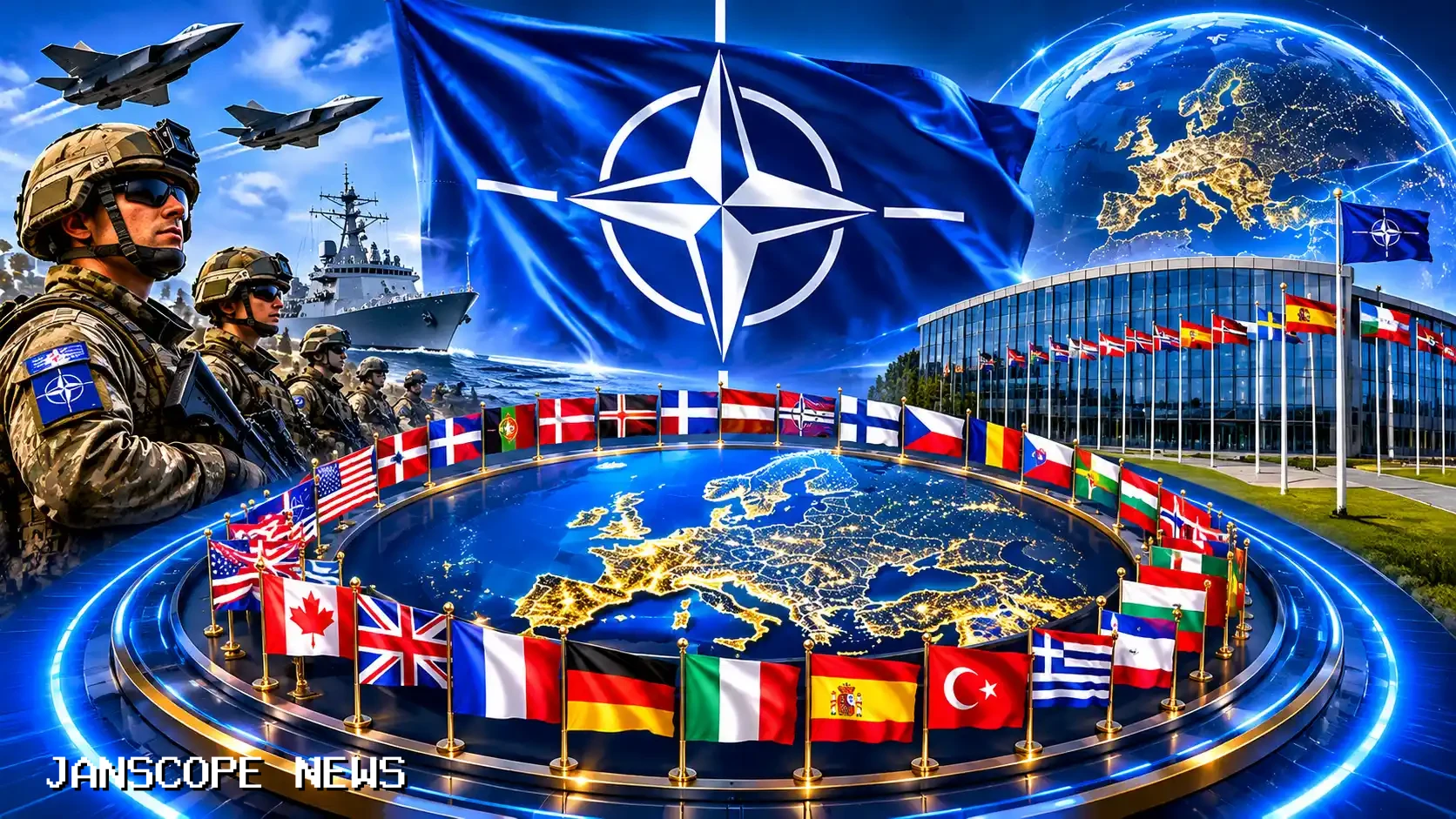
What is NATO and who are its members?
The North Atlantic Treaty Organization (NATO) is a political and military alliance of 32 countries across Europe and North America founded in 1949. If you are asking what is NATO and who are its members, the short answer is a collective defense pact stretching from Washington and Ottawa to Helsinki and Ankara, where an armed attack against one country is treated as an attack against all.
Most explanations stop at the history textbook version: 12 founding countries signed a treaty after World War II to counter the Soviet Union, and the club grew to 32 states after Finland joined in 2023 and Sweden followed in 2024. That tells you how it started, not how it actually runs today. In practice, NATO is a massive coordination machine governed by money, unanimous votes, and logistical effort. It has almost no troops of its own, relies on two distinct financial buckets that voters constantly confuse, and requires months or years of bureaucratic and legislative grinding whenever a new country wants in.
What is NATO and who are its members today?
As of 2026, the alliance has 32 member states: 30 in Europe and 2 in North America. Every member holds an equal veto at the table, whether it is the United States with a defense budget approaching a trillion dollars or Iceland, which has no standing army at all.
You can check the official NATO member countries directory for diplomatic profiles, but looking at them chronologically shows how the alliance's borders shifted east over seven decades:
The 12 founders (April 1949)
Belgium
Canada
Denmark
France
Iceland
Italy
Luxembourg
Netherlands
Norway
Portugal
United Kingdom
United States
Cold War additions (1952 to 1982)
Greece (1952)
Turkey (1952)
Germany (joined as West Germany in 1955; unified Germany remained a member in 1990)
Spain (1982)
Post-Cold War expansion in Central and Eastern Europe (1999 to 2009)
Czechia (1999)
Hungary (1999)
Poland (1999)
Bulgaria (2004)
Estonia (2004)
Latvia (2004)
Lithuania (2004)
Romania (2004)
Slovakia (2004)
Slovenia (2004)
Albania (2009)
Croatia (2009)
Balkan and Nordic expansions (2017 to 2024)
Montenegro (2017)
North Macedonia (2020)
Finland (April 2023)
Sweden (March 2024)
People often assume the European Union and NATO are roughly the same club. They are not. Four EU states—Austria, Cyprus, Ireland, and Malta—sit outside NATO. Conversely, non-EU states like the US, Canada, the UK, Norway, Iceland, and Turkey provide the bulk of NATO's military weight and geographic reach.
How collective defense works when a member is attacked
The core of the alliance is the North Atlantic Treaty, a surprisingly short document of just 14 articles. Three of those articles do almost all the heavy lifting: Articles 3, 4, and 5.
Most public debate fixates on Article 5, the collective defense clause. Here is what people usually get wrong: Article 5 does not automatically trigger World War III or force every allied parliament to dispatch soldiers the minute a border is crossed. Read the exact wording and you find a deliberate legal cushion. If an armed attack occurs, each member must assist the attacked ally by taking action "it deems necessary, including the use of armed force." That can mean sending fighter jets and armoured brigades, or it can mean sharing intelligence, providing medical logistics, or opening airspace.
Why does the deterrent work if the legal text leaves wiggle room? Because of the forward deployment effort built under Article 3. NATO puts multinational battlegroups from the US, UK, Germany, Canada, and other allies directly on the soil of frontline states like Poland, Lithuania, Latvia, and Estonia. If an adversary attacks Estonia, they cannot avoid hitting British, French, or American troops on day one. The physical deployment removes the political hesitation.
Before anything reaches Article 5, members use Article 4. This lets any ally call an emergency meeting of the North Atlantic Council whenever it believes its territorial integrity or security is threatened. Poland, Turkey, and the Baltic states have triggered Article 4 multiple times over the last decade in response to airspace violations and border crises. Article 5 itself has been invoked only once in history—by European and Canadian allies in support of the United States after the September 11 attacks in 2001.
Geography also sets hard limits on Article 5. Under Article 6, collective defense covers attacks in Europe, North America, Turkish territory, and islands in the North Atlantic north of the Tropic of Cancer. That geographic boundary is why the Falklands War in 1982 did not trigger NATO intervention, and why an attack on Hawaii or Guam falls outside the treaty's automatic geographic scope.
What NATO costs and who actually pays the bill
Money is the single most misunderstood part of the alliance. Politicians regularly talk about countries "owing" money to NATO or being delinquent on their dues, as if the organization runs a central bank account where members wire 2% of their national income.
In reality, NATO finance splits into two completely separate buckets: indirect defense spending and direct common funding.
The 2% GDP guideline (and the push toward 3%+)
Indirect contributions are simply what each country spends on its own national military—paying its own soldiers, buying its own tanks, and maintaining its own bases. At the 2014 Wales Summit, allies agreed to move toward spending at least 2% of their Gross Domestic Product (GDP) on their own defense by 2024, with at least 20% of that budget going toward major new equipment and research. By the 2023 Vilnius Summit, that 2% figure changed from a ceiling to a floor.
For years, most European capitals treated the target as an aspiration rather than a bill. That changed after 2022. According to official NATO defense expenditure data, only a handful of allies met the 2% benchmark in 2014. By 2024 and 2025, more than two-thirds of the 32 members cleared the 2% hurdle, led by Poland spending above 4% of its GDP, followed by Estonia and the United States above 3%. In 2025 and 2026, negotiations among allies have shifted toward raising that baseline floor to 2.5% or 3% of GDP to refill depleted ammunition stockpiles and fund air defense networks.
Direct common funding: the actual NATO budget
The second bucket is the money actually wired to Brussels to keep the lights on at headquarters, run integrated command centers like SHAPE in Mons, maintain shared radar planes (AWACS), and build fuel pipelines and airfields. Compared to national defense budgets, this shared pot is tiny—roughly €3.8 billion to €4.5 billion a year across all 32 countries combined.
Every member pays into this common pot using a strict cost-sharing formula based on Gross National Income. Nobody is behind on these dues. Under the recent cost-sharing arrangements following the accession of Finland and Sweden, the United States and Germany each pay roughly 16% of this central budget, the UK pays around 11%, and France pays about 10%. The US used to pay over 22% of the direct budget, negotiate-capped its share down to match Germany's in 2019, and European allies picked up the difference.
The time, effort, and politics required to join NATO
Article 10 of the treaty says any "European State" in a position to further the treaty's principles and contribute to North Atlantic security can be invited to join. Notice the first catch: you have to be in Europe. Colombia, Japan, South Korea, and Australia are close operational partners, but they cannot become full treaty members without amending the 1949 treaty itself.
For eligible European states, the time and effort required to get inside the alliance vary wildly depending on two things: military compatibility and unanimous politics.
The application and Membership Action Plan (MAP): Historically, applicants spent years in a MAP cycle—reforming defense ministries, establishing civilian control over the armed forces, rooting out intelligence leaks, and upgrading gear to NATO standards (everything from rifle ammunition calibers to encrypted radio frequencies). North Macedonia spent over 20 years in this waiting room, largely held up by a dispute with Greece over its constitutional name until the 2018 Prespa agreement.
Accession talks and protocols: Once allies agree in principle to invite a candidate, technical teams meet in Brussels to verify legal and financial readiness. The existing 32 ambassadors then sign Accession Protocols.
The 32-parliament ratification gauntlet: This is where timelines break down. Every single existing member must ratify the new member's entry according to its own domestic law—usually a parliamentary or senate vote, plus a presidential or royal signature. Because decisions require 100% consensus, one holdout capital can freeze the entire alliance. Finland applied in May 2022 and finished the entire process in less than 11 months—the fastest accession in modern NATO history—joining in April 2023. Sweden applied on the exact same day with a sleek, modern military that had already trained with NATO for decades, yet waited nearly two full years (until March 2024) while negotiating bilateral security and defense-export demands from Turkey and waiting on parliamentary scheduling in Hungary.
Depositing the instrument of accession: Once all 32 ratifications are sent to the US State Department in Washington (which holds the original 1949 treaty), the new member deposits its own formal paperwork and is immediately covered by Article 5.
Why some aspirants are still waiting outside
Four European countries have formally declared their goal to join NATO or sit at various stages of the accession pipeline: Bosnia and Herzegovina, Georgia, Ukraine, and—more quietly in policy debates—Kosovo (which is not recognized by four current NATO members).
Bosnia and Herzegovina participates in a Membership Action Plan, though internal political divisions between its entities stall unified progress. Georgia was promised at the 2008 Bucharest Summit that it would eventually become a member, followed by Ukraine.
Why haven't Ukraine and Georgia crossed the finish line? Because of the consensus rule and the reality of active territorial conflict. While the treaty text does not contain a sentence explicitly banning countries with border disputes from joining, accepting a country currently fighting a war would immediately put all 32 allies into an active Article 5 confrontation with a nuclear-armed Russia. At recent summits in Vilnius and Washington, allies waived the bureaucratic MAP requirement for Ukraine and created the NATO-Ukraine Council to speed up weapon standardization, but stated that a formal invitation will only come "when Allies agree and conditions are met."
How the alliance runs day to day without its own army
A common misconception is that the Secretary General in Brussels—a post held by former Norwegian Prime Minister Jens Stoltenberg for a decade until former Dutch Prime Minister Mark Rutte took over in October 2024—commands a massive standing NATO army.
The Secretary General is a civilian diplomat, not a general. His job is wrangling 32 heads of state into agreeing on policy. Because NATO operates by consensus, there is no majority voting. If 31 countries want to launch a mission and one small country objects, the mission does not happen under the NATO flag.
On the military side, run by the Military Committee and the Supreme Allied Commander Europe (SACEUR—historically always a four-star US general), NATO owns almost no military hardware directly. Aside from a fleet of E-3A AWACS surveillance aircraft registered in Luxembourg and a group of Alliance Ground Surveillance drones in Italy, every ship, tank, fighter jet, and soldier wearing a NATO patch belongs to an individual member nation. When NATO sets up an air policing mission over the Baltic Sea or a naval patrol in the Mediterranean, it asks national capitals to contribute forces for a set rotation. The cost of deploying those troops usually falls on the country that sends them ("costs lie where they fall"), which is why smaller members feel the financial pinch of overseas deployments so acutely.
Common questions about NATO membership and rules
Can a country be kicked out of NATO?
No. The North Atlantic Treaty has no suspension or expulsion clause. Even if a member violates democratic norms, buys weapons from an adversary, or blocks consensus for years, the other 31 members have no legal mechanism inside the treaty to vote them out. Diplomatic pressure and bilateral sanctions are the only tools available.
Can a member country leave NATO voluntarily?
Yes. Article 13 states that after the treaty has been in force for 20 years, any member may leave by giving a one-year notice of denunciation to the US government. No country has ever fully withdrawn from the alliance, though France pulled out of the integrated military command structure in 1966 under Charles de Gaulle before rejoining fully in 2009, and Greece briefly exited the military command between 1974 and 1980.
Why is Iceland in NATO if it has no military?
Geography. Iceland sits right in the middle of the GIUK (Greenland-Iceland-UK) gap, the vital naval and air choke point between the Arctic and the North Atlantic. During the Cold War and again today, monitoring submarines and aircraft moving through that corridor is essential for protecting North America and shipping lanes to Europe. Iceland contributes by hosting the Keflavik air base, running a coast guard, funding peacekeeping, and allowing allied fighter jets to rotate through its airspace.
Does NATO membership mean hosting foreign military bases or nuclear weapons?
Not automatically. Norway and Denmark joined in 1949 with self-imposed policies against hosting permanent foreign bases or nuclear weapons on their soil during peacetime. Finland and Sweden recently negotiated bilateral defense cooperation agreements with the US to allow troop access, but each sovereign parliament retains total veto power over whether foreign troops or nuclear assets can enter its territory.
What happens if two NATO members go to war with each other?
The treaty was written to counter external threats, leaving an awkward legal blind spot if one ally attacks another. Greece and Turkey have come close to armed conflict several times over Cyprus and Aegean maritime boundaries. In theory, the attacked member could invoke Article 5 against the aggressor ally, though in practice, the US and major European powers step in bilaterally to force de-escalation before the alliance fractures.
Why did Finland and Sweden abandon decades of military non-alignment?
For generations, Helsinki and Stockholm calculated that staying outside military alliances kept tensions low in the Baltic Sea region while they maintained strong domestic militaries. Russia's full-scale invasion of Ukraine in February 2022 upended that math overnight. Both governments concluded that being a close NATO partner offered all the risks of alignment without the legal shield of Article 5, prompting joint membership applications within three months of the invasion.
Are NATO and the United Nations connected?
NATO is an independent organization, not a branch of the UN, though the North Atlantic Treaty explicitly anchors its legality in Article 51 of the UN Charter, which affirms the inherent right of individual or collective self-defense. Several past NATO operations, such as peacekeeping missions in Bosnia, Kosovo (KFOR), and Afghanistan (ISAF), operated under mandates approved by the UN Security Council.
Who are NATO's "Major Non-NATO Allies," and is that the same thing?
"Major Non-NATO Ally" (MNNA) is a legal designation under United States law, not a NATO status. Washington grants it to close partners like Australia, Japan, South Korea, Israel, Brazil, and Colombia to ease defense trade and research. Separately, NATO itself maintains formal partnerships-such as the Indo-Pacific Four (Australia, Japan, New Zealand, South Korea) and the Partnership for Peace—for intelligence sharing and joint exercises, none of which carry an Article 5 defense guarantee.


No comments yet — be the first to share your thoughts!