
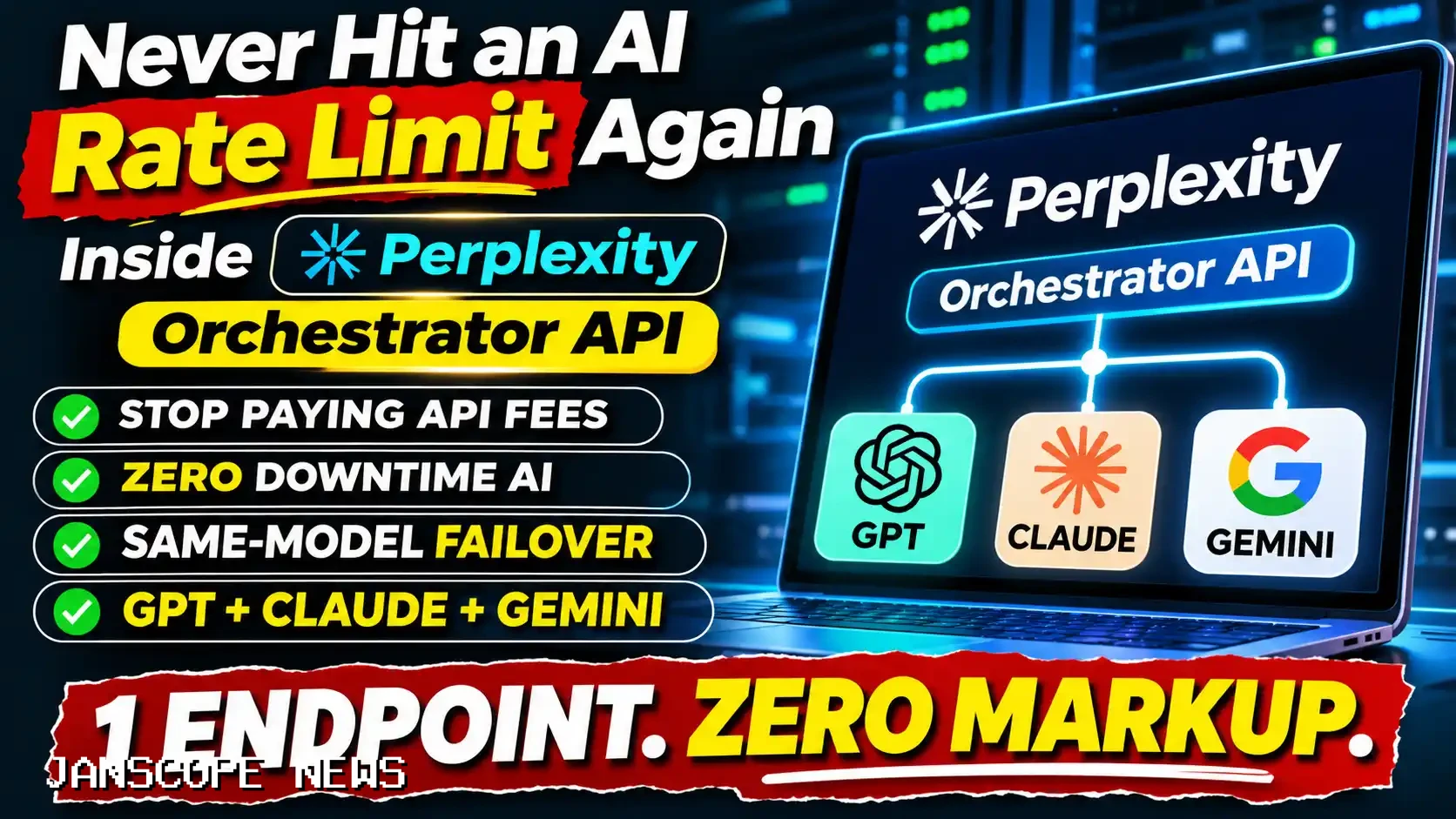
Perplexity Orchestrator API: When a primary model provider goes down or hits a rate limit, production AI applications usually stall or require brittle custom fallback scripts. Perplexity built the Orchestrator API to solve this reliability bottleneck at the infrastructure layer, offering direct pass-through access to frontier models with zero token markup.
For developers evaluating whether to replace OpenRouter, LiteLLM, or custom routing wrappers, the reality is more nuanced than the marketing pitch. Here is what the service actually does, where the common assumptions break down, and how to test it in production.
Myth vs. fact: what developers get wrong about the Perplexity Orchestrator API
A common misconception is that the Perplexity Orchestrator API is just another wrapper around Perplexity's own Sonar search models. In practice, it is a separate multi-provider inference layer hosted on the Perplexity API Platform that routes traffic to third-party foundation models without forcing web search grounding onto every call.
Another frequent misunderstanding involves how failover behaves during an outage. Many teams assume an API gateway will automatically swap a failing Claude model for a GPT alternative, which often breaks strict system prompts and JSON schemas. Perplexity relies primarily on same-model failover, shifting your request to a secondary cloud host running the exact same model weights—such as moving from an Anthropic direct endpoint to AWS Bedrock or Google Cloud Vertex AI—before falling back to different model families.
How same-model failover and routing operate under the hood
When your application sends a completion request, the gateway evaluates real-time latency, error rates, and regional capacity across upstream hosts. If the primary endpoint returns a 429 rate limit or 5xx server error, the router retries the identical payload on an alternate host within milliseconds.
Key architectural traits include:
OpenAI SDK compatibility, requiring only a base URL and API key change in existing codebases.
Model-provider prefixing (such as specifying a provider and model slug) so you can pin a specific model while letting the router pick the healthiest host.
Configurable fallback chains that let you define whether the system should fail over to another host of the same model or step down to a faster, cheaper model if all hosts are degraded.
Unified billing and usage telemetry across all routed providers inside a single dashboard.
Getting started with the Perplexity Orchestrator API
Because the endpoint follows standard chat completions conventions, migration takes minimal code changes. According to the Perplexity Orchestrator Quickstart documentation, you point your existing OpenAI client to Perplexity's base URL and pass your Perplexity API key.
Python
from openai import OpenAI

client = OpenAI(
    api_key="YOUR_PERPLEXITY_API_KEY",
    base_url="https://api.perplexity.ai"
)

response = client.chat.completions.create(
    model="anthropic/claude-3-7-sonnet",
    messages=[
        {"role": "user", "content": "Explain consistent hashing in two sentences."}
    ]
)

print(response.choices[0].message.content)
Before pushing this to production, check how your error-handling middleware interacts with upstream retries. If your client library already performs aggressive exponential backoff, disable or lengthen client-side timeouts so they do not cancel a request while the gateway is mid-failover.
Pricing, latency trade-offs, and hidden limitations
Perplexity positions the gateway around pass-through pricing, meaning you pay the upstream provider's standard per-token rate rather than a percentage surcharge. For high-volume teams, consolidating spend onto one invoice simplifies procurement, though you give up direct enterprise volume discounts negotiated individually with AWS, Google, or Anthropic.
There are also operational trade-offs to weigh:
Network hop overhead: Every request passes through Perplexity's edge infrastructure before reaching the model host, adding a small amount of first-token latency compared to direct provider connections.
Feature lag: Newly released provider-specific parameters—such as specialized caching headers or beta tool-use flags—often take longer to appear in unified gateways than in native SDKs.
Data residency and compliance: Routing traffic across multiple cloud hosts complicates strict data residency rules unless you explicitly restrict which underlying hosts your account can use.
Frequently asked questions about the Perplexity Orchestrator API
Is the Perplexity Orchestrator API free to use?
There is no separate gateway fee or per-token markup on standard model rates, so you only pay for the input and output tokens consumed by the underlying models. You still need a funded Perplexity API account with active billing credits to authenticate requests.
How does it differ from OpenRouter or LiteLLM?
OpenRouter acts as a broad marketplace covering hundreds of open-weight and proprietary models with a small credit fee, while LiteLLM is an open-source proxy you host and maintain yourself. Perplexity's service is a managed gateway focused specifically on high-availability enterprise routing, pass-through pricing, and automated same-model failover across major cloud hosts.
Does the Orchestrator API include Perplexity's web search by default?
No. Unlike Perplexity's Sonar endpoints, which automatically execute live web searches before generating an answer, the Orchestrator API routes directly to standard foundation models unless you explicitly invoke search-enabled models or tools.
Which AI models are supported on the platform?
The gateway supports frontier models from major labs including Anthropic (Claude series), OpenAI (GPT and o-series reasoning models), Google (Gemini series), and xAI (Grok), along with select open-weight models hosted on partner inference clouds. Check the Perplexity official blog for current model additions.
Can I force requests to stay on a specific cloud host?
Yes. While dynamic routing is the default behavior for maximum uptime, you can configure provider preferences or model routing rules in your API request parameters if compliance or latency requirements dictate a specific host.
What happens if every host for a model goes down?
If same-model failover exhausts all healthy hosts for your requested model, the API will either return an upstream error or automatically route to a secondary fallback model if you have configured an explicit fallback list in your request payload.
Does using an API gateway affect prompt caching?
Prompt caching works when requests hit the same underlying provider cache, though frequent cross-host failover can reduce cache hit rates compared to pinning a single provider endpoint. For workloads heavily dependent on prefix caching, test cache hit metrics under load before enabling unrestricted multi-host routing.
Is the Orchestrator API compatible with the official OpenAI SDK?
Yes. It uses the standard chat completions schema, meaning existing Python, TypeScript, and Go applications built on the OpenAI SDK work by swapping the base_url and api_key parameters.



No comments yet — be the first to share your thoughts!