
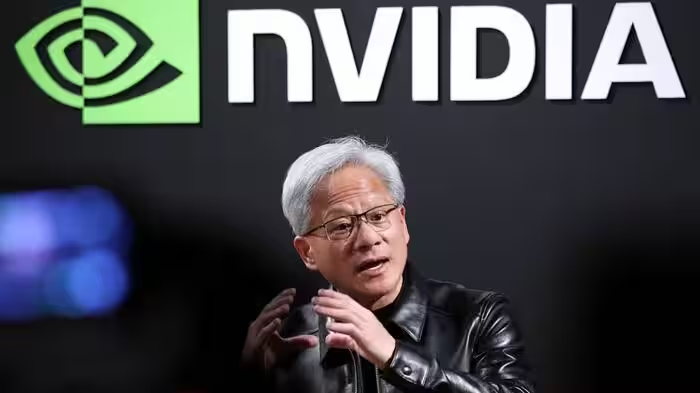
NEW DELHI, Nov. 11, 2026 -- Nvidia lost more than $400 billion in market value across a brutal two-day Wall Street sell-off that ended Tuesday, November 10, 2026, after co-founder and CEO Jensen Huang confirmed a close personal relationship with Alice Huang, a major shareholder in Singapore-based cloud provider Megaspeed International. US intelligence officials are scrutinizing whether Alice Huang has links to Chinese intelligence and whether Megaspeed routed restricted Nvidia AI processors to buyers in China, pulling the chipmaker's valuation down to $4.078 trillion.
For institutional investors, the sell-off is not about a tabloid personal story. It is about compliance risk and supply chain leakage. When the executive running the world's primary AI hardware supplier admits personal proximity to an offshore cloud operator already under the microscope of the US Department of Commerce Bureau of Industry and Security (BIS), institutional desks reduce exposure first and wait for legal findings later.
How Tuesday's sell-off hit Nvidia's stock and Jensen Huang's net worth
Nvidia shares fell more than 6% during intraday trading on Tuesday, November 10, 2026, before closing down 5.47%. That two-day slide erased roughly $400 billion from the company's market capitalization, leaving Nvidia valued at $4.078 trillion at Tuesday's close.
During the worst of Tuesday's session, Nvidia briefly slipped to third place among the world's most valuable public companies before recovering slightly at the closing bell to hold the number two spot behind Apple. You can track the company's official share count and institutional governance filings through Nvidia Investor Relations.
The equity drop hit the chief executive's personal balance sheet immediately. According to the Bloomberg Billionaires Index, Jensen Huang lost $7.96 billion on Tuesday alone, bringing his two-day net worth decline to $15 billion. That drop pushed the 63-year-old Taiwan-born chief executive down to 13th place on the global wealth ranking, with an estimated net worth of $141 billion as of November 11, 2026.
Who is Alice Huang and why is Megaspeed International under US scrutiny?
At the center of the market's reaction is 42-year-old Alice Huang, an executive of Chinese origin who holds a major stake in Singapore-based cloud-computing firm Megaspeed International. On Sunday, November 8, 2026, Jensen Huang acknowledged having a close personal relationship with her.
US intelligence officials suspect Alice Huang may have ties to Chinese intelligence operations, according to reports cited in the provided source material and competitor coverage on Navbharat Times. Beyond counterintelligence questions, American regulators are examining Megaspeed International's commercial infrastructure. Specifically, US authorities suspect Megaspeed has been providing customers inside China with access to advanced Nvidia AI processors that are barred from direct shipment to the country under strict Washington export controls.
How offshore cloud routing challenges US chip export controls
To understand why traders wiped $400 billion off Nvidia's valuation in 48 hours, look at how modern semiconductor sanctions work in practice. Washington restricts the physical export of high-density AI accelerators to Chinese entities to slow advanced military and commercial model training.
In practice, enforcing physical border checks on server racks is only half the problem. Two major gray-zone channels keep compliance officers awake at night:
1. Remote cloud compute leasing (IaaS loopholes)
A cloud provider registered in a neutral hub like Singapore can legally apply to buy thousands of advanced GPUs for local data centers. If that provider then leases bare-metal compute capacity over the internet to clients in Beijing or Shenzhen, or quietly transfers hardware across secondary regional subsidiaries, it undercuts the goal of US export rules.
2. Know-your-customer (KYC) verification for partner networks
Hardware makers rely on audited distribution channels and end-user certificates to prove their chips stay with approved buyers. When an offshore cloud company is suspected of channeling compute or hardware to restricted buyers, regulators check whether the chipmaker's internal compliance teams missed red flags. Adding a personal relationship between the chipmaker's CEO and the cloud firm's major shareholder turns a standard trade-compliance inquiry into a corporate governance crisis.
How Nvidia's board and market analysts are reacting
Corporate boards treat personal conflicts of interest involving regulated counterparties as high-priority legal threats. Following the Sunday admission and subsequent regulatory chatter, legal and governance scrutiny has tightened around how Nvidia vets regional cloud partners and whether internal disclosures were handled according to board rules, a theme tracked closely across global financial coverage including The Guardian and NDTV Profit.
In India, RPG Enterprises Chairman Harsh Goenka weighed in on the controversy on social platform X, using wordplay on the executives' shared surname and the company's financials. Goenka wrote that when China and America meet, wonders can happen, calling it a meeting of "Huang with Huang." He pointed out that Jensen Huang scaled Nvidia's revenue at "megaspeed" over the past four years from $27 billion to $400 billion while keeping gross margins above 70%, joking that competitors feeling "Envy-dia" probably wished they had played their "chips" right.
Goenka's post highlights the exact tension investors are weighing right now. Nvidia's underlying financial engine -- $400 billion in revenue and 70%-plus gross margins -- remains unmatched in the semiconductor sector. Yet that rapid four-year expansion relied heavily on hyperscale and regional cloud buyers in Asia, the exact segment now facing potential regulatory bottlenecks.
What investors and compliance watchers need to track next
If you hold semiconductor equities or track global technology policy, separate the personal headlines from the regulatory triggers that actually alter company cash flows:
Formal BIS or DOJ inquiries: Watch for official subpoenas or Entity List updates from the US Commerce Department targeting Singapore-based cloud intermediaries. If Megaspeed International or related third-party data centers are placed on restricted trade lists, Nvidia could see delayed shipments across Southeast Asian distribution hubs.
Board-level independent reviews: Institutional funds require formal separation between personal executive relationships and commercial allocation of scarce GPU inventory. Look for Form 8-K filings with the US Securities and Exchange Commission (SEC) detailing independent legal audits of Megaspeed's allocation history.
Southeast Asian GPU allocation audits: Expect tighter customer vetting across Singapore, Malaysia, and Taiwan data center operators, which can lengthen sales cycles for enterprise server deployments over the next two quarters.
Frequently asked questions about the Nvidia sell-off and Megaspeed allegations
Why did Nvidia stock drop over $400 billion in November 2026?
Nvidia lost more than $400 billion in market value over two trading days ending Tuesday, November 10, 2026, after CEO Jensen Huang admitted to a close personal relationship with Alice Huang, a major shareholder in Singapore cloud firm Megaspeed International. Reports that US officials suspect Alice Huang of intelligence ties and Megaspeed of supplying restricted Nvidia AI chips to Chinese clients triggered the institutional sell-off.
How much did Jensen Huang's net worth fall during the two-day drop?
Jensen Huang's net worth fell by $15 billion across the two-day period, including a $7.96 billion drop on Tuesday, November 10, 2026. According to the Bloomberg Billionaires Index, the decline left his net worth at $141 billion and moved him to 13th place among the world's richest individuals.
What is Nvidia's market cap after the November 10, 2026 close?
After falling 5.47% at the close on Tuesday, November 10, 2026, Nvidia's market capitalization stood at $4.078 trillion. It remains the world's second most valuable company behind Apple, after briefly slipping to third place during Tuesday's intraday trading.
What is Megaspeed International and why are US officials investigating it?
Megaspeed International is a cloud-computing company based in Singapore in which Alice Huang is a major shareholder. US officials suspect the company may have helped customers in China access advanced Nvidia AI processors despite American export bans prohibiting the sale of high-end AI chips to Chinese entities.
Have Nvidia's core revenues and gross margins changed?
No immediate changes to past financial results have been announced. As noted in market commentary during the sell-off, Nvidia grew its annual revenue from $27 billion to $400 billion over a four-year span while maintaining gross margins above 70%. The stock drop reflects forward-looking governance and export-compliance risk rather than a sudden drop in current data center demand.



No comments yet — be the first to share your thoughts!